
Why game gacha isn't truly random
You pull 30 times on a 10% gacha and get nothing. At some point you've thought, "Is this thing rigged??"
Here's the fun part: a lot of games really do tweak their randomness. Just not the way you'd expect. Not to give you less, but to make bad luck feel less unfair.
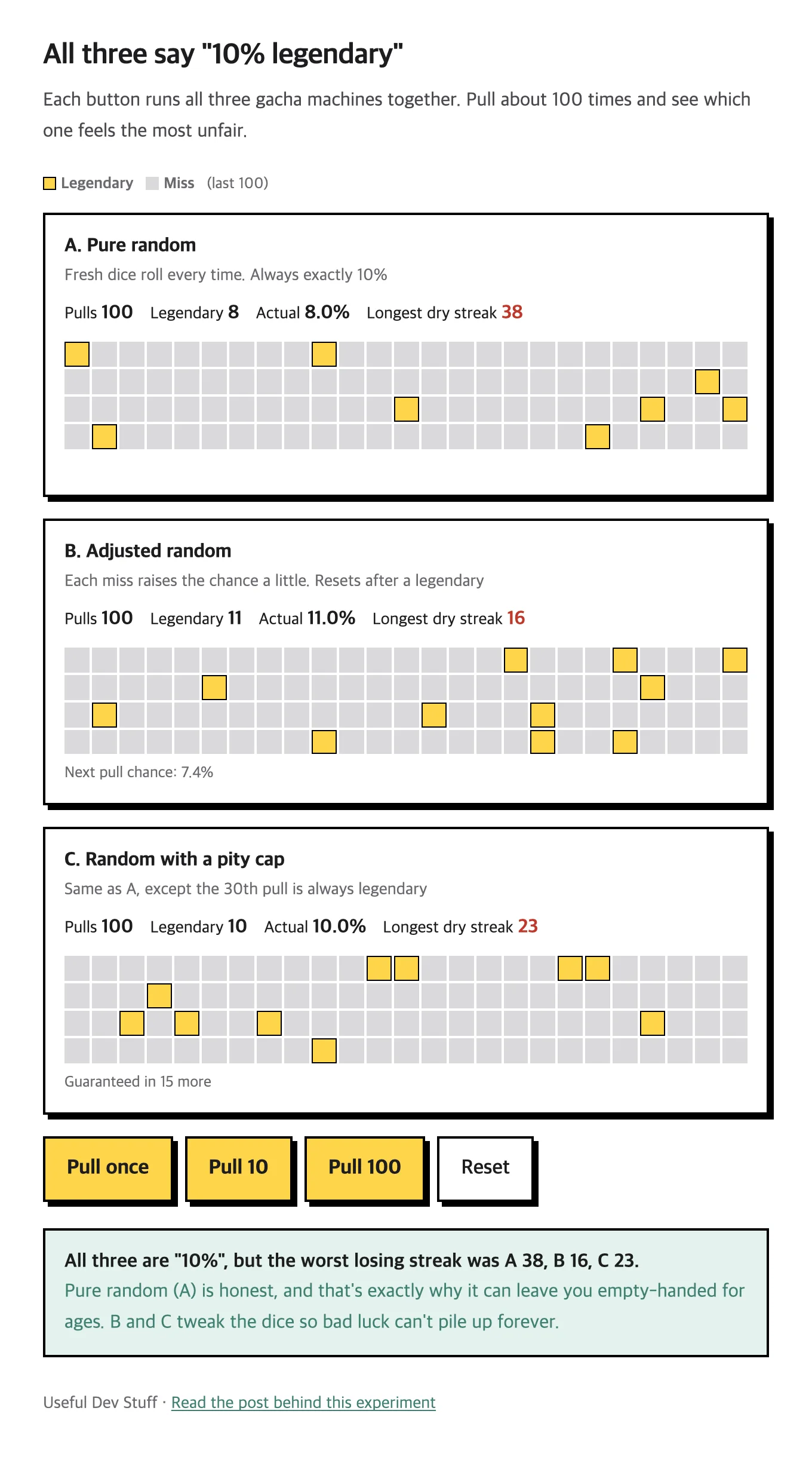
These are three gacha machines I built, each pulled 100 times. All three say "10% legendary." The top one missed 38 times in a row.
Real randomness is harsher than you think
Start with true randomness. Every pull is a fresh 10% roll. It doesn't care how many times you've missed.
That's honest. But do the math and it gets scary.
Chance of missing 30 times in a row at 10%: about 4%
4% sounds small, but out of 100 players, 4 of them burn 30 pulls on nothing. I simulated 100 pulls 2,000 times, and 1 in 10 runs had a dry streak longer than 40.
Our brains can't accept that. After enough misses, it feels like a win is "due." That's the gambler's fallacy. The dice don't remember the last roll. People do.
So true randomness is fair on paper and feels rigged in practice.
So games quietly adjust the dice
Here's the developer's problem: "I want to keep the rate at 10%, but I don't want anyone missing 30 times in a row."
There are three common fixes.
1. Raise the chance after every miss (adjusted random)
Start with a low chance. Each miss raises it a little. On a hit, it resets. The average stays at 10%, but losing streaks get much shorter.
To land on 10%, the first pull starts around 1.5% and goes up by about 1.5% after every miss. Dota 2 and Warcraft III are known to handle chance effects like critical hits and evasion this way.
2. Guarantee it after N pulls (pity)
Keep pure randomness most of the time, but the Nth pull always wins. Gacha games call this "pity."
However bad your luck, you know exactly how long you have to hold out.
3. Draw from a bag
This is what Tetris does. Put all 7 pieces in a bag, shuffle, and draw them one by one. When the bag is empty, start a new one.
So no piece can vanish for ages. That's how it saves you from waiting forever for the long straight piece.
Try it: all three are 10%, which one feels worst?
Words only go so far, so I built three gacha machines. Every button pulls on all three together. Hit "Pull 100" a few times.
- A. Pure random: always 10%. Sometimes a brutally long dry streak
- B. Adjusted random: each miss raises the chance. Shortest dry streaks
- C. Random with a pity cap: same as A, but the 30th pull is always legendary
After a few runs, the "Actual" rate settles near 10% for all three, but the longest dry streak spikes only for A. It's not just a feeling. A really is the most unfair one.
It's not just games
The same problem shows up outside games.
Music shuffle is the classic example. A truly random shuffle sometimes plays the same artist back to back, and people decide shuffle is "broken." So some apps deliberately shuffle to spread things out evenly.
Sid Meier, the designer behind the Civilization series, has told a similar story. When players lost a fight the game showed as 75% in their favor, they got angry, so the game quietly tilted the odds in the player's favor beyond what it showed.
What people want isn't true randomness. It's something that looks random and feels fair.
So there's no rigging at all?
That's a different story. Everything above tweaks things so you feel less cheated. Paying out less than the posted rate is just lying.
In Korea, since March 2024, games are legally required to disclose the odds of loot box items. Many games list their pity count next to the odds too, so it's worth checking before you pull.
The one-line version
Game randomness isn't truly random because true randomness is too cruel for people. Next time you hit a long losing streak, figure out how far you are from pity.