
How do spammers get your phone number? I tried guessing numbers
A text says "Dear member" from a company I never signed up for. In Korea, people reported over 3.92 million spam texts in January 2025 alone. So where did they get my number??
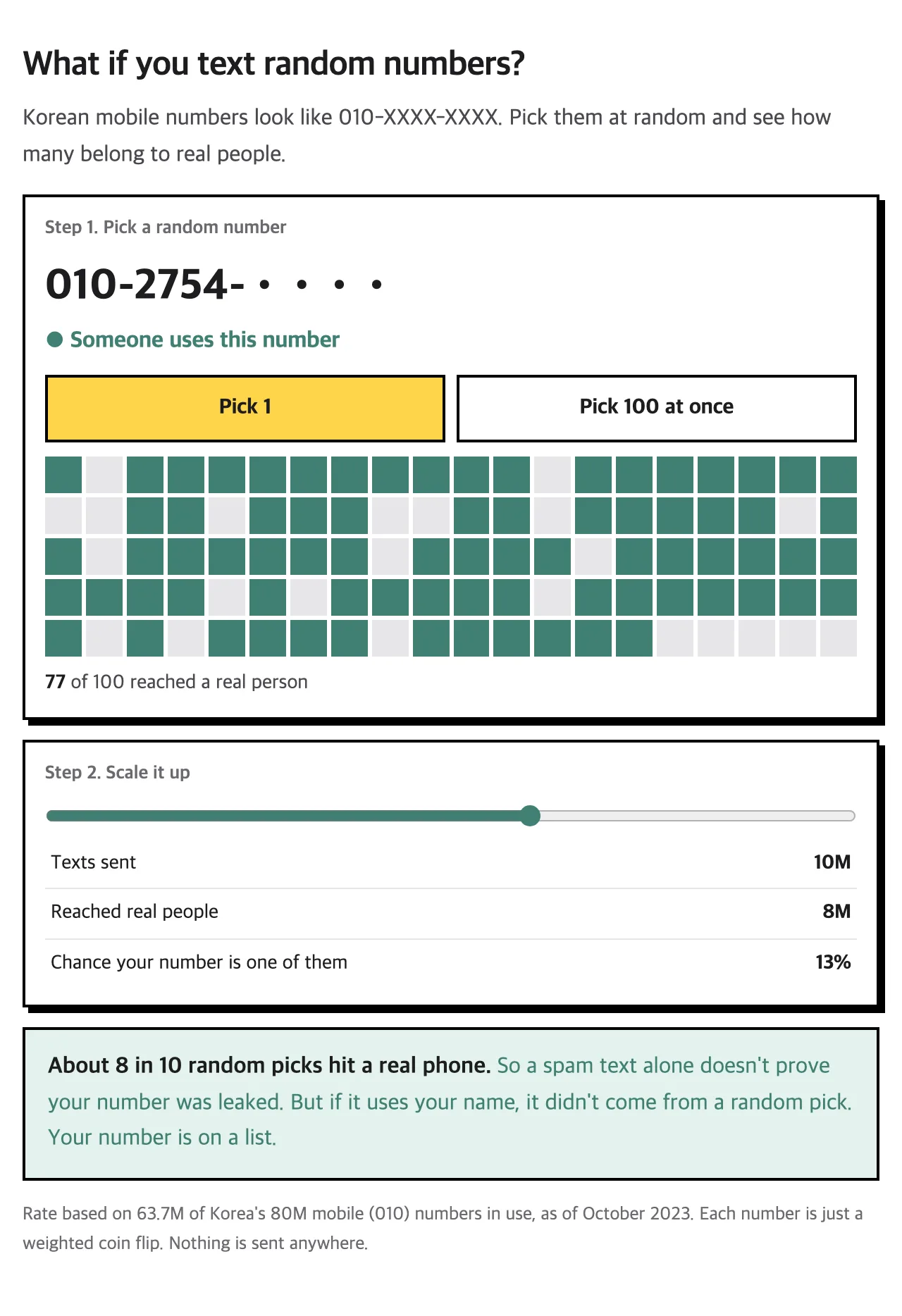
I looked up how many phone numbers are actually in use. Then I built a calculator for what happens if you text numbers at random. The answer is a bit of a letdown. About 8 out of 10 hit.
Two ways to get your number
Spammers can find your number in roughly two ways.
- A list: names and numbers gathered somewhere, then leaked or sold
- Guessing: making up numbers and sending anyway
A list comes with your name. A guess only knows the number. That difference turns out to be useful.
Phone numbers are nearly full
Korean mobile numbers are 010 followed by eight digits. There are 80 million 010 numbers available, and as of October 2023, 63.7 million were in use. That's 79.6%, a record high.
The figure comes from a Korean telecom policy institute, released through a lawmaker's office. In other words, pick any number and there's an 8 in 10 chance someone owns that phone.
Try it: text random numbers
Pick numbers one at a time or 100 at once. The slider scales it up.
When I picked 100, 77 were real. Send 10 million texts to different numbers, and there's a 13% chance yours is one of them.
To be honest, I couldn't find an official source saying spammers actually do this. But the math works. So a spam text alone doesn't prove your data was leaked.
If it knows your name, it's a list
It's different if the text uses your name. You can guess a number. You can't guess who owns it.
A 2022 report by Korea's Digital Daily said leaked personal data keeps getting resold for years. It also said some vendors will send calls and texts for you if you hand them a list. That's one more reason the big breaches from my last post matter.
Closing the sender's door
Spam usually goes out through bulk texting services. So in November 2024, the Korean government announced a plan against illegal spam that targets those services.
In April 2026, Korea's communications regulator approved rules for a sender certification system. Bulk texting companies need to be certified. Send spam for gambling or illegal loans, and the certification can be revoked.
There's a number suggesting it's working. In an op-ed, a commissioner at the regulator said average spam per person fell from 16.34 texts a month in early 2024 to 7.91 in early 2025. That comes from an official's column, though, and it doesn't say who measured it.
What can you do?
- Don't tap links in the text
- Report it with your phone's spam report button (in Korea, you can also call 118)
- If you agreed to marketing messages when signing up somewhere, turn that off in the service's settings
- Worried about a leaked password? Check a breach lookup service for your email
Korea has its own service for checking leaked accounts, and many countries have similar ones. These check account details like emails and passwords, not phone numbers.
The one-line version
A spam text doesn't mean you were hacked. Random guesses hit 8 in 10. But if it knows your name, you're on a list.
Sources: 010 number usage (Newsspace, Korean) · January 2025 spam reports (Seoul Economic Daily, Korean) · Resale of leaked data (Digital Daily, Korean) · Sender certification rules (Newsis, Korean) · Spam crackdown review (Digital Daily, Korean) · Spam per person (Financial News op-ed, Korean)