
How does the YouTube Shorts algorithm know you so well?
I meant to watch one Short before bed. Then it was 2 a.m. In Korea, people spent an average of 113.6 billion minutes a month on YouTube in early 2026. That's more than 20 times Netflix. So how does YouTube know what I like this well??
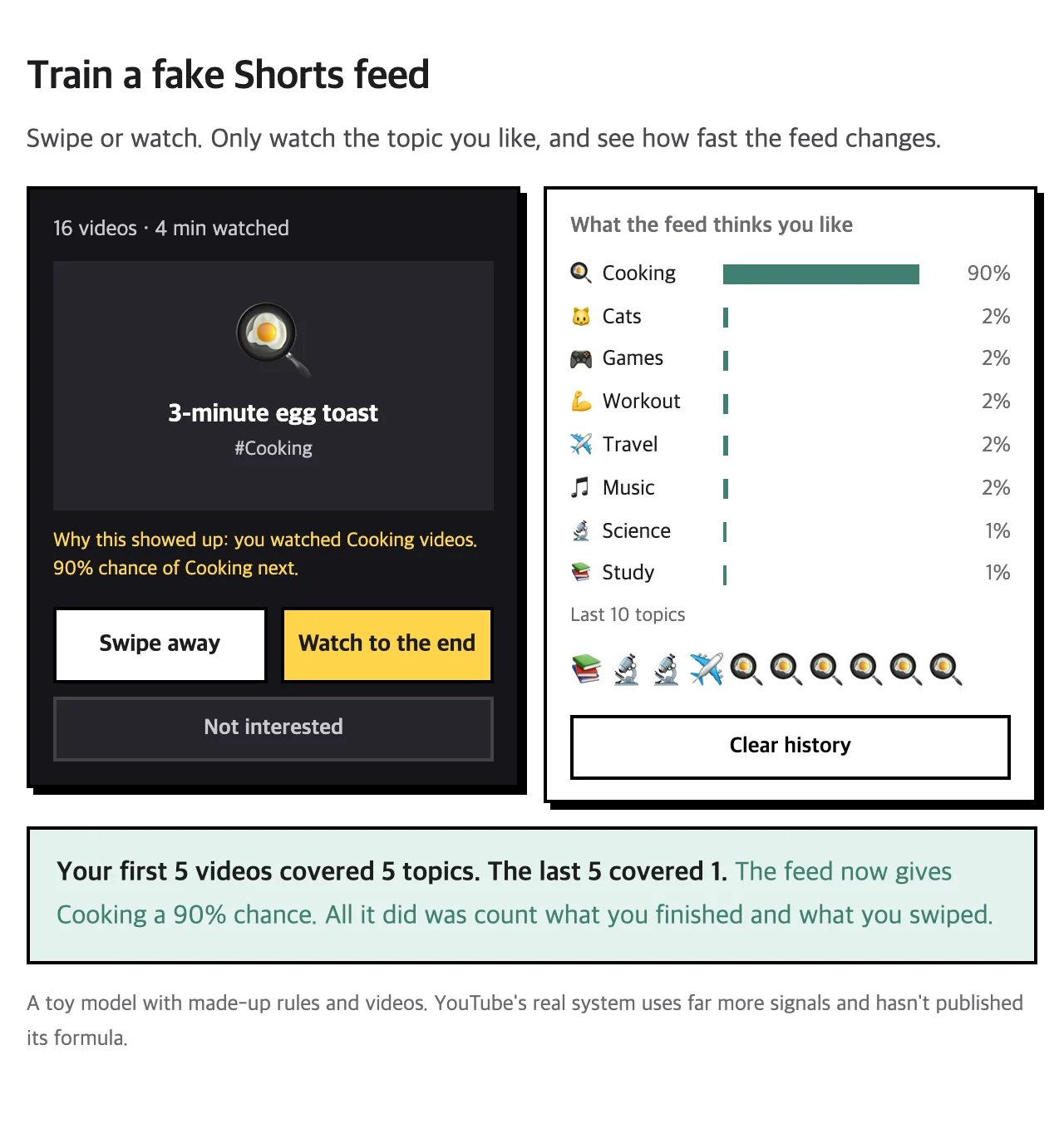
I read what YouTube has said about its recommendations, then built a fake Shorts feed you can train just by swiping. Short version: after 16 videos, my feed had narrowed down to one topic.
Recommendations are a guessing game
Two terms first.
- Recommendation algorithm: the math that picks the next video. Like a cafe owner who remembers a regular's usual order
- Signal: a trace you leave behind. What you tapped, finished, or swiped
In 2021, YouTube explained its system on its official blog. To find videos you'll be satisfied with, it looks at clicks, watch time, survey responses, sharing, likes and dislikes. It also says there's no set formula. The system shifts as your viewing habits change.
Counting clicks didn't work
At first, videos that got clicked a lot did well. Then, in 2011, YouTube realized a click doesn't mean you actually watched.
So in 2012 it added watch time. According to YouTube, views dropped 20% right after. Videos that got the click but lost you in seconds stopped getting pushed as much.
Watching long isn't the same as liking it
Watch time had a hole too. It can't tell a video playing in the background from one you loved. So YouTube asks some viewers to rate a video from one to five stars. Only four- and five-star views count as "valued watch time."
Most people never answer, so YouTube trained a model to predict what they would have said. Those satisfaction surveys that pop up under a video sometimes? That's what they're for.
What's different about Shorts?
YouTube's help page only says the Shorts feed is personalized to reflect what it thinks you want to see next. It hasn't said how much swiping counts.
There is a hint, though. YouTube shows creators the share of viewers who stayed past the first few seconds of each Short. So it is measuring whether you stay or swipe.
From here on, this is my own reading. A Short is quick, and you decide to swipe within a second or two. Swipe through 10 in a minute and the feed gets 10 verdicts. Your taste piles up much faster than with long videos.
Try it: train a fake Shorts feed
Pick one topic. Watch only that to the end, and swipe everything else.
In my run, the first 5 videos covered 5 topics. The last 5 were all cooking. That took 4 minutes of demo time. The only rule: finishing raises a topic's score, swiping lowers it.
I also made this toy slip in a random topic 10% of the time. That mimics the odd video that shows up out of nowhere. If a feed only showed what you already like, you'd never find anything new.
Why does it end at 2 a.m.?
This part is my interpretation too.
1. There's no stopping point. The next video is already loaded. You never hit an end screen.
2. The verdicts come fast. Each one takes seconds, so the feed tunes itself to you quickly.
3. The better it fits, the less you swipe. And not swiping keeps you watching, which becomes another signal.
How to reset it
If your feed has gone strange, YouTube's own controls can help.
- "Not interested" in a video's menu (⋮): tell it directly you don't want this
- "Don't recommend channel": drop that channel entirely
- Delete or turn off watch history: stop past viewing from shaping what you see
Hit "Clear history" in the demo and you'll get the idea. The feed goes back to knowing nothing. Watch a few videos to the end again, and it tilts right back.
The one-line version
Shorts doesn't read your mind. It just counts, very quickly, what you finished and what you swiped.
Sources: On YouTube's recommendation system (YouTube Blog, 2021) · How recommendations work (YouTube Help) · Manage your recommendations (YouTube Help) · Shorts analytics (YouTube Help) · YouTube usage in Korea (Hankyung, Korean)