
Why do banks and big companies keep getting hacked? What the investigations found
Every time I open the news, someone else has been breached. In Korea alone: 39.5 million TVING accounts, 33.7 million records at Coupang, and in October, banks. These companies have money and security teams. So how does this keep happening??
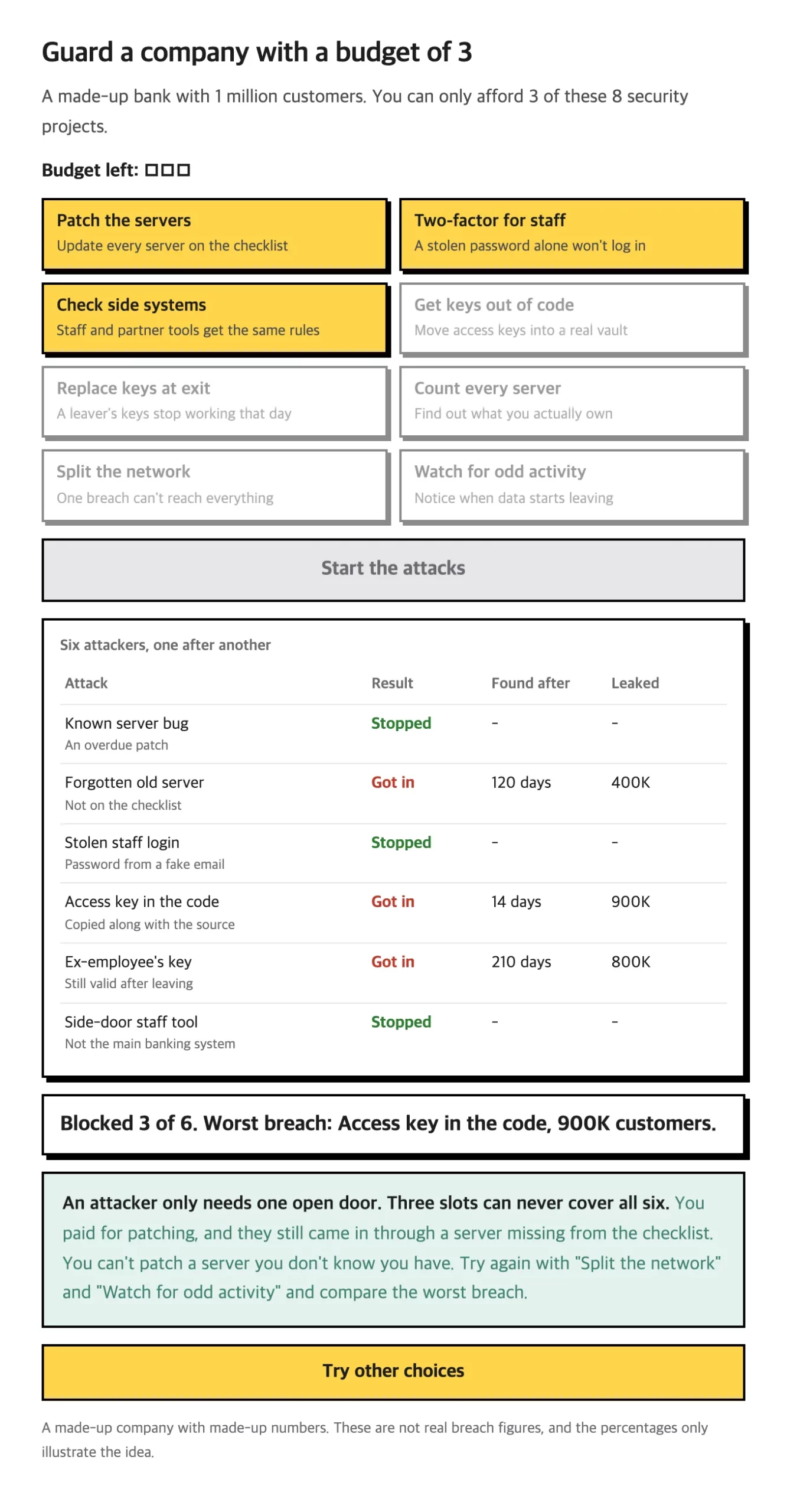
I got curious, read the official investigation findings, and built a simulation where you try to stop it yourself. Nobody in those reports has green text pouring down a screen. It's mostly about where the keys were kept and how many servers a company thought it had.
Attackers rarely break the wall
Hacking sounds like drilling into a vault. The findings read much more like getting hold of a key or finding a door nobody locked.
Three terms first.
- Access key: a long string that works like a key to a server
- Source code: the blueprint of a service
- Patch: a repair that closes a known hole
The four cases below have causes published by investigators or by the company itself. Some breach sizes aren't final yet, and I've noted which.
TVING: live access keys inside the source code
TVING is a major Korean streaming service. The government's investigation says the attack began with a developer's access key. How that key was first stolen couldn't be determined, and police are investigating.
With it, the attacker took 361 development projects. Inside that code were 43 access keys for the live service, and 2 of them were used to get in. Information from the development side led straight into the live service.
Investigators said a 2024 penetration test had already flagged keys in source code, and it wasn't fixed. They also noted about 4 dedicated security staff, against 149 developers.
The announced figure is 39.54 million accounts. That includes duplicates, since one person can have several accounts. Korea's privacy regulator will publish the detailed scale.
Coupang: a signing key that outlived the job
Coupang is a major Korean online retailer. A signing key is like a company stamp on an ID badge. If the stamp matches, the server believes the badge.
Investigators found that a former developer used a signing key obtained while employed to forge badges after leaving. The process for changing keys when someone left was inadequate, and the key was hardcoded, which made changing it harder.
It went on for about seven months, and the company reportedly learned of it from the attacker's own emails. Investigators counted about 33.67 million name and email records from access logs. The privacy regulator will confirm the final number.
Lotte Card: one server missing from the list
The hole was an Oracle WebLogic flaw made public in 2017. According to the company, an engine for a barely used service was left off its asset list, so it missed the patch.
Material submitted to Korea's National Assembly put it at 1 of 48 WebLogic servers. Fix the other 47, and the one you missed can still be the way in. The company's breach affected about 2.97 million people.
SK Telecom: malware dating back to 2021
SK Telecom is a major Korean mobile carrier. The joint investigation found the first malware was planted in August 2021. Account details stored in plaintext on another server, meaning readable with no encryption, were used to reach a core server.
Malware was found on 28 of 42,605 servers, and about 26.96 million SIM records leaked, counted by subscriber ID. For some periods the logs were missing, so investigators couldn't say whether more had leaked.
The bank incidents are still under investigation
In October 2026, reports of customer data leaks at Korean banks and lenders piled up. The systems named were often loan-agent lookup pages and staff support tools, more than online banking itself.
The cause hasn't been confirmed. Whether it was one attacker, or whether AI was involved, hasn't been established. The reports I read were about leaked data, and none said money had vanished from accounts.
Try it: guard a company with a budget of 3
You're the security lead now. A made-up bank has 8 security projects, and you can afford 3.
Play at least twice. First go with your gut, then try swapping in Split the network and Watch for odd activity.
My first go was patching, two-factor and side systems. Result: 900K customers lost through a key in the code. The numbers are invented, but the setup mirrors the cases above.
So why does it keep happening?
Here's how I'd sum it up. Part of this is my own reading, not the investigators'.
1. Defenders have to get everything right. A company guards a thousand doors. An attacker needs one.
2. Companies don't know everything they own. Older companies pile up unused services and servers whose owners left.
3. Fixing things is scary. If a patch stops payments, that's a major incident too. So it gets put off. Verizon's 2026 report puts the median time to patch at 43 days, up from 32 the year before.
4. Convenience fights security. Putting a key in code is easy today. Changing it later is the hard part.
5. It pays. In the same report, exploiting vulnerabilities became the top way in for the first time in 19 years. Third parties were involved in nearly half of breaches.
What can you actually do?
You can't stop a company from being breached. You can limit how far it spreads afterward.
- Use a different password for every site
- Turn on two-factor login for accounts that matter
- When you get a breach notice, change that password first
- Don't tap links in "breach compensation" texts. Go to the official app or site yourself
That last one matters most. Right after a breach makes the news, scam messages using it as bait tend to follow.
The one-line version
In the big breaches with published causes, nobody smashed a wall. Keys were poorly managed and doors were forgotten.
Sources: TVING findings (Korea.kr) · Coupang findings (Newsis) · Coupang signing key (Boannews) · Lotte Card CISO remarks (Boannews) · Lotte Card Assembly material (Digital Daily) · SKT final results (Digital Daily) · Verizon 2026 DBIR summary (Help Net Security)