How does the "I'm not a robot" checkbox spot robots?
You click "I'm not a robot" a few times a day. But think about it for a second. Couldn't a robot just click a checkbox too??
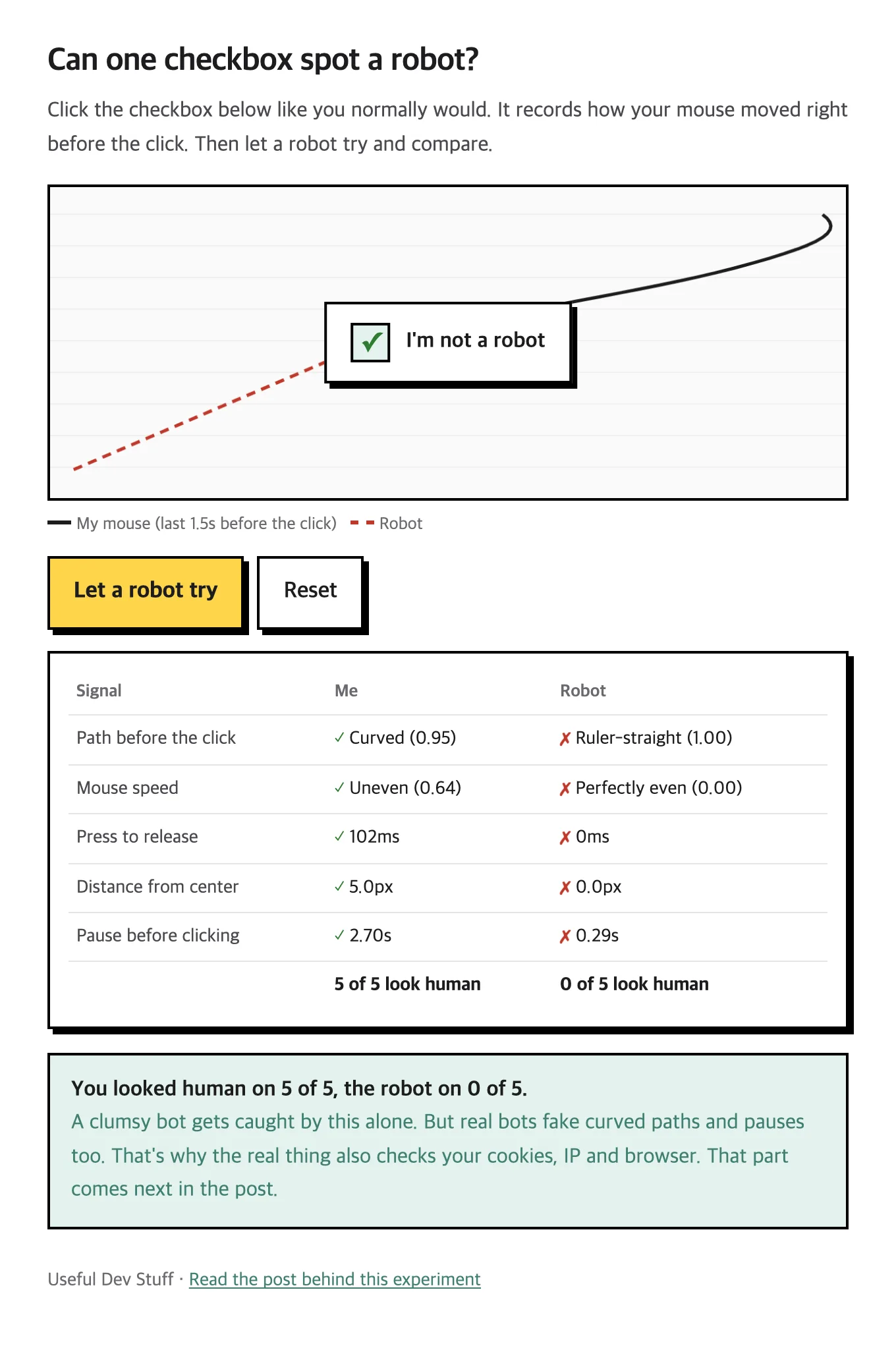
So I built one to find out. It records how your mouse moves in the 1.5 seconds before you click the checkbox. The black line is a human. The red dashed line is a robot. Pretty different, right?
The answer isn't the click. It's how you got there
The checkbox isn't really a quiz. It cares less about the click and more about everything leading up to it.
When Google launched this checkbox in 2014, it described it the same way. It looks at what you do before, during and after the click to judge the risk. If it's still not sure, that's when you get a "pick the traffic lights" puzzle.
Google doesn't say exactly what it checks or how much. If it did, bot makers would just copy it. So what follows is an experiment at the level of "here's the kind of thing it can look at."
Human hands are messier than you think
My experiment only looks at five things.
- Path: humans curve the mouse on the way. Robots draw a ruler-straight line
- Speed: humans speed up and slow down. Robots move at a steady pace
- Press to release: a finger takes about 0.1 seconds. A robot can do 0
- Where you click: humans miss the center by a few pixels. Robots hit dead center
- Pause: humans read the page first. Robots click the moment it loads
The fun part is that all five are human flaws. Moving sloppily, missing a little, hesitating for no reason. That clumsiness is exactly what proves you're human.
Try it: me vs. the robot
Click the checkbox the way you normally would. Then hit "Let a robot try" and it compares the two on the same checks.
I came out human on 5 of 5. The robot got 0. On a phone there's no mouse path, so it only checks press time, position and the pause.
But bots can fake all that
True. The robot in this experiment is clumsy on purpose. Real bots draw curved paths and add random pauses.
So real services don't trust the mouse alone. From what's publicly known, they also look at things like these.
- Cookies: has this browser been browsing around normally before?
- IP address: does a lot of bot traffic come from it, or a burst of requests?
- Browser setup: do the screen size, fonts and settings look like a real browser?
Think of the checkbox as a security guard saying "hello" at the door. The real check already happened. Your walk, your clothes, whether they've seen your face before.
The next version, released in 2018, dropped the checkbox entirely. It scores you the whole time you're on the site and just returns a number from 0.0 to 1.0.
Why the picture puzzle loops forever
The endless "select all traffic lights" loop is common enough to show up in search suggestions. You're definitely human, and you're on your fifth set of traffic lights.
It happens when one of those signals looks very suspicious. The usual suspects:
- VPN or public Wi-Fi: lots of shady requests have come from that IP before
- Blocked cookies or a private window: there's no "normal browsing" history
- Ad blockers and privacy extensions: your browser looks unusual
Turning off the VPN, or switching to the browser you normally use, often fixes it. Cookies in particular matter more than you'd expect. I dig into why in Why every site asks you to accept cookies.
Old CAPTCHAs made you read books
Older CAPTCHAs asked you to type out squiggly letters. The name CAPTCHA itself means "an automated test to tell computers and humans apart."
reCAPTCHA had a clever twist. It showed people words from scanned old books that computers couldn't read. So every robot check also helped digitize books.
Then machines got better at reading squiggly text than people, and that approach died. Since "can you solve the puzzle" stopped working, the test moved to "how do you behave."
The one-line version
"I'm not a robot" doesn't check the click. It checks the clumsy human trail leading up to it. If you pass with a single click, the test was already over before you clicked.